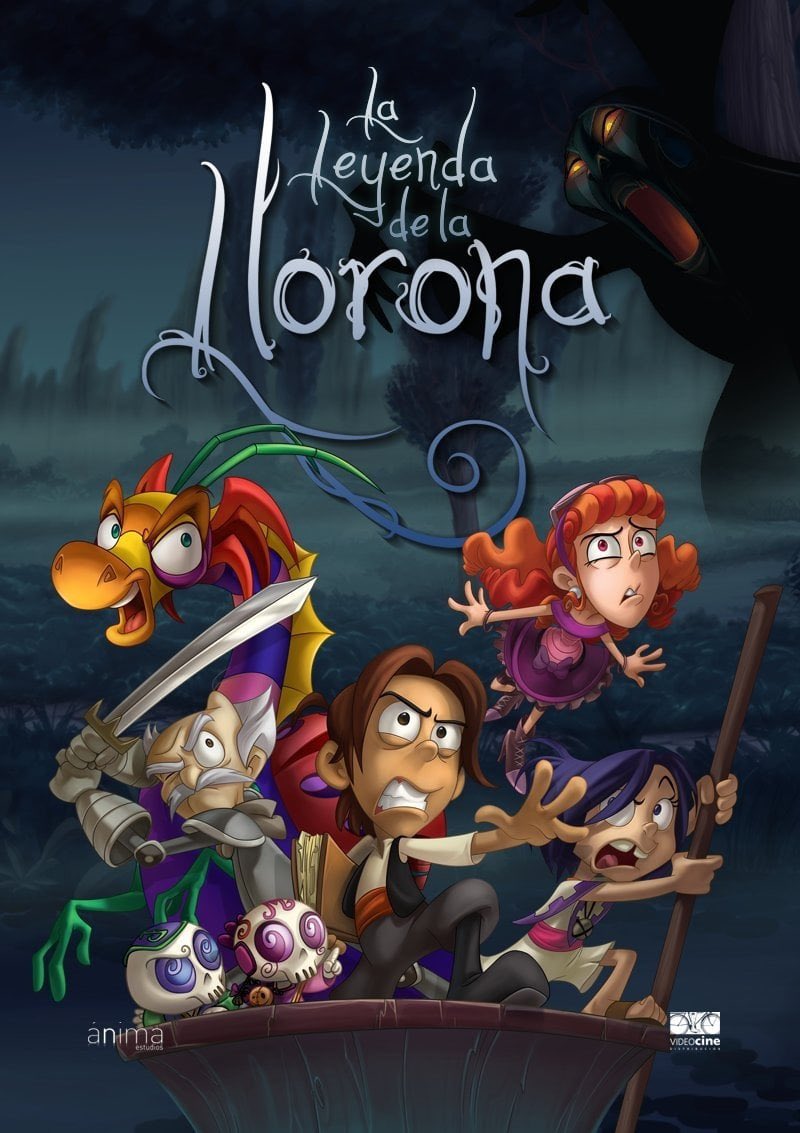
Letterboxd Review: La Leyenda de la Llorona - 2011


Story - Based on a famous Mexican legend, a group of kids must stop the ghost of a woman whose guilt over the drowning of her own children leads her to abduct youngsters who wander the woods at night in this subtitled, Spanish-language animated adventure.
Cast - Yair Prado, Mónica del Carmen, Rafael Inclán, Andrés Couturier
Crew - Alberto Rodríguez (Director/Writer), Ricardo Arnais (Writer), Omar Mustre (Writer), Jesús Gumán (Writer)
Runtime - 81 minutes


I’ve not been really a big fan of the franchise, but this one is perhaps the best of all the movies related to Leyendas.

It uses the most popular tale of La Llorona as a base, it works as a kid's movie and it is very entertaining (various physical gags and comedy). I wish it wasn’t so A and B plot, they often do that in these stories where one is more serious and the other is just comedy and absurd, it gives the movie a lack of focus and tonal shift.

The animation, compared to the first movie is vastly improved, I haven’t seen them first in many years but I’ve tried and that’s the aspect I hate the most. In this installment, the designs are more consistent, detailed and the animation is more fluid, the 3D objects are not as distracting as they once were.


Comments

Popular posts from this blog

Review: Resan (The Journey) - 1987

  Story  -   Petter Watkins' global look at the impact of military use of nuclear technology and people's perception of it, as well as a meditation on the inherent bias of the media, and documentaries themselves. Cast  -  Peter Watkins Crew  -  Peter Watkins (Director) Runtime   - 873  minutes           "I think to remove the veil of ignorance from the world is the most direct way at least to achieve enlightenment." Sometimes it is incredibly difficult to sit and watch a long movie, after all, the way of life in the XXI century has been accelerating to the point that 90-minute movies are consumed in 20 different parts on a tiny screen while commuting to work. This is a world that 15 years ago I would have never imagined. I believe on this occasion, watching a movie divided into 19 different sections has helped me to appreciate and embrace what it is trying to say on a different level. It is hard for someone in 2024 to...

Opinion: Propaganda and "modern" Right-Wing ideas.

              "Will God Forgive Us?"           ​Have we taken for granted the power of propaganda films? We are almost 100 years removed from WW2 and the several communist revolutions that took place during the 20th century. I believe that during this period of time, when people from the past are starting to become impossible to relate to or to understand, we often dismiss their experiences and history as something foreign, from a less civilized time, it is easier to latch on to iconography and the images produced during that era. Propaganda movies are often victims of this simplification, and no country or society is more likely to have such results as Nazi Germany. Perhaps the biggest example of this is Triumph of the Will , in which filmmakers (and modern right-wing viewers) have distilled the 2-hour movie as a compilation of "based" content, where massive rallies, unification, standardization, and epic scenery are the ...

300 - Review

            "A new age has begun, an age of freedom. And all will know that 300 Spartans gave their last breath to defend it."           ​It is hard to describe a movie from the past two decades that has had as much impact on young men as 300 . Even when we compare it to films like Fight Club , Drive , or John Wick , 300 seems to speak in a way that almost any man is captured by its aesthetics and mythology. To dismiss a movie, especially one with such magnitude and power as "popcorn entertainment," is at best, ignorant, and at worst, a facilitator of its message and, in the case of this film, its cryptofascist message. Let us be clear for a second: movies, like any other art form, are not created in a vacuum by soulless and thoughtless people. The zeitgeist, culture, time period, and events all affect the media we consume, produce, create, and enjoy. German cinema from the 1930s and 40s served as a way to understand the Führer pro...